The largest city of Rajasthan, also the capital of the state was our busiest city yet. I think even busier than Mumbai. Driving here was nerve racking, even for me as the passenger. Unfortunately, we don’t have any photographs of our nervous journey through the city.
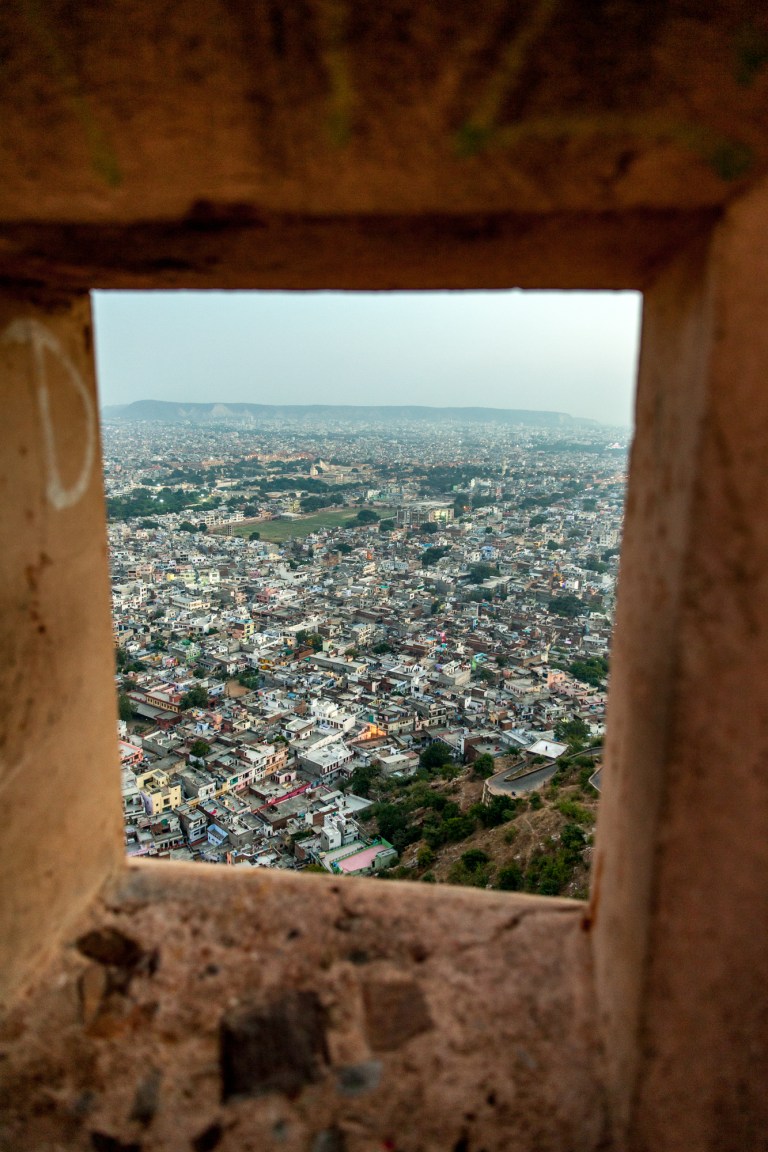
The city was founded in 1727 by Jai Sing II, after whom the city got its name. Jai Singh II was the ruler of Amer, a town seven miles north of the city, decided to move the capital of his Kingdom to this new town called Jaipur to accommodate a growing population. Interestingly, he built the city under architectural and planning guidance hence the gridded layout of part of the city.
You may have heard that Jaipur is often referred to as ‘The Pink City’. This began in 1876 when the city received H.R.H Albert Edward, Prince of Wales as a guest. To this day, part of the city remains pink and is a large draw for tourists. Jaipur makes up one point of the golden triangle tourist circuit in Rajasthan along with Delhi and the Taj Mahal in Agra.


We visited many of the major tourist attractions during our stay in the city including the lesser known Royal Gaitor. As the resting place of a number of Rajput Kings, this place is very quiet to visit and ponder. Beautiful architecture hints at a celebration of life with some magnificent details carved from large pieces of white marble. Words cannot do the craftsmanship justice, photographs will have to do for now until you go.


An early morning drive out of the city took us to Amer Fort. Former home of Jai Singh II mentioned above, the fort dates back to the 16th Century. The wall that starts and ends at Amer to create the fortification is the 3rd largest wall in the world.
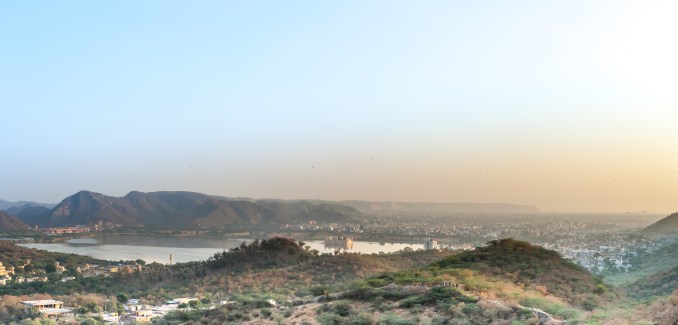
We visited the fort with a guide who helped us to notice features and to understand the history of the fort. The following information has been derived from our tour.
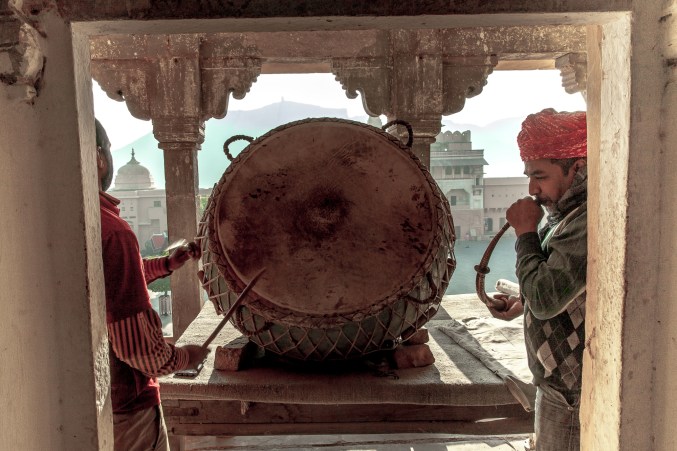
Built on a hill, the fort is perfect for being split into separate areas. Split into four courtyards, with each one being used for different functions. The first courtyard is the area for Royal visitors to be received and welcomed to the fort. A large archway on one side of the courtyard is for the Royals, and on the opposite side a smaller archway for servants and workers to enter and exit through. Looking directly at the a large archway is a small open room on the first floor where musicians would be ready to play drums and a horn to receive guests. We went up the room and played some drums with the resident musicians. Loud drums bounced and echoed around the courtyard. This courtyard was also used for victory parades on return from battles.
The second courtyard is elevated above the first, and as such the lower courtyard can be viewed upon from the safety of above. A mixture of Mughal architecture (arches and domes) and Hindu architecture (lotus flowers and brackets) form different elements of each courtyard; hinting on the different rulers that lived here.


Access to the third courtyard is not direct, therefore hindering any potential invasion to the royals. Again, from the third courtyard the second courtyard below can be viewed from behind an ornately carved latticed screen. The lady of the house would therefore be able to await the return of the king, in privacy.


The fourth courtyard is where the many wives of the resident Maharaja (king) lived. Architecturally designed with a hidden courtyard behind each wife’s apartment so the chosen wife of the night would not be seen by anyone.
In order to protect the King from any invasion, there is a 2 km secret passage way from Amer fort to Jaigarh Fort higher up the hill. With this the royal family could secretly escape Amer to a place of safety on higher ground.
Jantar Mantar, another UNESCO world heritage site built in the centre of Jaipur, is a set of 19 astronomical instruments. Also built by Jai Singh II, the instruments allow astronomical observation with the eye.


We didn’t take a guide here, but after walking round for a while with a confused look on our faces, we regretted that we didn’t. A lot of the instruments looked very interesting in their capabilities and it would have been good to know what they could do. After googling a few of them during our visit we were able to get an understanding of a couple of them. The Vrihat Samrat Yantra instrument enables the user to tell the time down to intervals of two seconds. Standing 27 metres tall, the sundial is one of the largest in the world. A magnificent feat of engineering and astronomy considering it was built in 1734.


The Rasivalayas Yantra includes 12 instruments that measure the longitude and latitude of a celestial object. Once a zodiac sign comes inline, it is visible along the plane of the viewing angle and steps. More information about the instruments at can read here.


In Jaipur, walking round the city provided us with plenty of opportunities to photograph the everyday lives of the locals. Here are a flavour of what we saw.


While in Jaipur I decided to buy a real pashmina shawl. I visited Akee International. The owner Akib is extremely knowledgeable about pashmina and the craft of weaving and embroidery. Originally from Kashmir himself, he grew up with his family weaving and making pashminas. Did you know pashmina is a type of wool from only a certain breed of mountain goat in the Himalayas in Kashmir? Here are some photos of a few he showed us during our time in his shop. You can visit his website here to find out more about the process of making these beautiful garments.


 On the Move
Great photos and background info on blue and pink
Cities. Think we need to paint North Kilworth pink! Will start work on it when we get home!
Mum xx
LikeLike